 Anglo-American University in Prague
 AAU Hosts Two-Part Discussion on Franz Kafka’s Lessons for Leadership in a Post-Truth World
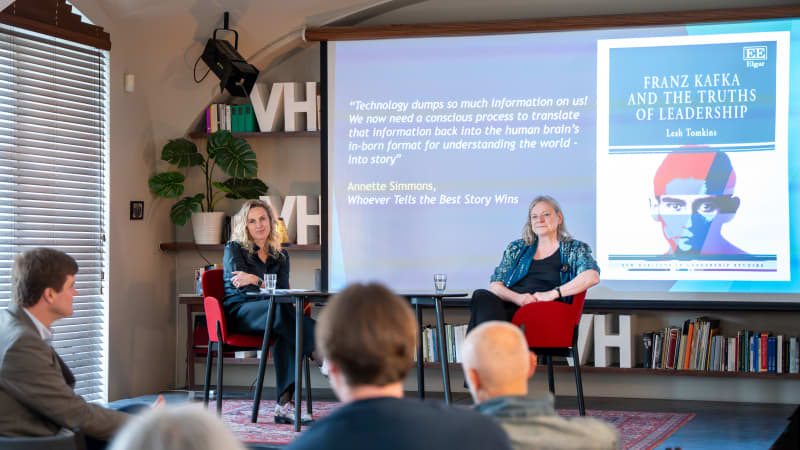

Anglo-American University hosted a two-part lecture and discussion series, Franz Kafka’s Lessons for Leadership in a Post-Truth World, bringing together leading academic and public intellectual voices to explore the relevance of Kafka’s work for contemporary leadership.
The series opened at AAU with Leah Tomkins, a scholar-practitioner whose work bridges academia and leadership practice, in conversation with Tomáš Sedláček, former economic advisor to the President of the Czech Republic and a renowned author on the philosophy of economics. The discussion continued at the Václav Havel Library, where Tomkins was joined by Zuzana Říhová, who moderated a second session focused on the broader implications of Kafka’s thought.
In her lecture, Tomkins challenged conventional interpretations of Franz Kafka, presenting him not only as a literary figure but as a thinker deeply engaged with questions of power, leadership, and authority. Drawing on her research, including work with original Kafka manuscripts at Oxford’s Bodleian Library, she explored how Kafka’s experiences in early 20th-century Prague informed his understanding of power dynamics.
A linguist by background, Tomkins approaches leadership through the humanities, arguing that many contemporary leadership challenges are rooted in language, narrative, and interpretation. Her book, Franz Kafka and the Truths of Leadership (2024), reflects this interdisciplinary approach, combining close textual analysis with practical insights for leadership in complex, modern environments.
Tomkins argued that leadership should not be understood solely as a position within a hierarchy, but as the ability to influence, shape meaning, and inspire others.
“Power belongs to whoever gets to shape the narrative and persuade others to accept it,” she noted, highlighting the central role of storytelling in leadership.
She further reflected on the relevance of Kafka’s work in today’s “post-truth” environment, emphasizing that the stories leaders tell, the narratives audiences absorb, and the interpretations individuals construct all play a defining role in how reality is understood. In this context, Kafka offers a powerful lens through which to examine authority, responsibility, and the limits of control.
Across both sessions, the discussions connected literary insight with contemporary economic, political, and organizational questions. The exchange between Tomkins and Sedláček at AAU introduced perspectives grounded in economic thought and public policy, while the moderated discussion at the Václav Havel Library expanded the conversation into broader cultural and philosophical contexts.
The series offered students and faculty a valuable opportunity to engage with leadership through a humanities lens, reinforcing the value of interdisciplinary thinking in understanding complex global challenges.
Events such as this reflect AAU’s role in fostering dialogue that connects global scholarship with contemporary leadership challenges.