 Anglo-American University in Prague
 Pamir H. Sahill, Ph.D.
-
Lecturer and Researcher
- International Relations and Diplomacy
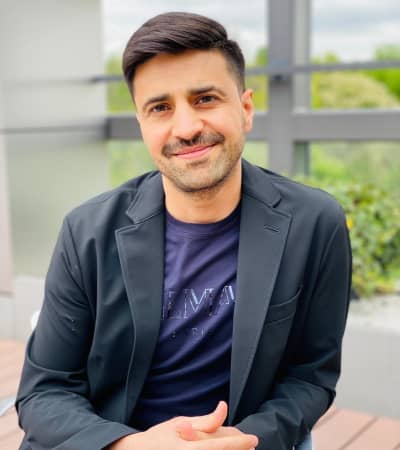
Pamir H. Sahill holds a doctorate in International Relations from Prague University of Economics and Business (Vysoká škola ekonomická v Praze). He is an Anglo-American University (AAU) alumnus and has been serving as a lecturer and researcher at the School of International Relations and Diplomacy since 2018.
He began university teaching in 2015 at Prague University of Economics and Business during his doctoral studies where he co-taught several courses including International Security Relations, International Security Relations after the End of the Cold War, and Asia in International Relations. In the last course he was responsible for the modules covering Afghanistan, Iran, Pakistan, and India as well as fragile states in Asia.
In addition to teaching at AAU, he has been serving as Associate Editor at the Elsevier journal Women’s Studies International Forum since 2024. In this capacity he assesses scholarly submissions on and originating from Central Asia, South and Southwest Asia, the Gulf, and the Middle East, including manuscripts addressing gender-based persecution, political repression, and human rights in those regions.
His recent publications critically assess the U.S.-led War on Terror in Afghanistan, offer an in-depth analysis of regional security and political dynamics, and examine the Taliban’s governmental discourse and its consequences for Afghans, particularly women. Earlier, his doctoral research focused on the discourses of the U.S. War on Terror and state-building in Afghanistan. In the dissertation, he developed two Foucauldian-inspired notions: the politics (and spaces) of confinement and abiopower. With the help of these concepts, he offers a contextual and critical understanding of the U.S. war and state-building discourses and their far-reaching implications for post-2001 Afghanistan and the region. His dissertation received the prestigious Josef Hlávka Award for 2021.
He is presently investigating how abiopower has been (and is) penetrating our societies, in what way this new technology of power will alter near-future security practices and warfare, and what its political and social implications are.
His current research interests revolve around reinterpreting Taliban ideology and theorizing the group’s foreign policy, the discourses and dynamics of right-wing violent extremism in Europe and North America, big data and surveillance capitalism in the age of artificial intelligence, the politics of the Anthropocene and climate change, and gender studies in the Global South.
Courses Taught
- Terrorism in Global Politics
- Topics in International Relations (IR)
- Current Issues in IR from Diplomatic Perspectives
- Theories of Globalization
Specializations
International security, (critical) terrorism studies, qualitative and interpretive research methodologies (e.g., (Critical) Discourse Analysis, textual analysis, situational analysis approach to Grounded Theory, archival research, and genealogy), state-building theory and practice, theories of globalization, post-colonialism and developmentalism, big data and surveillance capitalism, post-Marxism, (Foucauldian) poststructuralism, political Islam and Islamist revivalist ideologies, Taliban ideology and governmentality, and politics and security in Afghanistan, Iran, South Asia, the Middle East, and North Africa (MENA).
List of Publications
Monograph
- Sahill, P. H. (2024). Turbulent Afghanistan: A critical analysis of the US politics of confinement and the rise of the Taliban. Routledge. https://doi.org/10.4324/9781003416166
Doctoral Dissertation
- Sahill, P. H. (2021). Post-2001 Afghanistan: A critical analysis of the US WoT and state-building discourse(s) [Doctoral dissertation, Prague University of Economics and Business].
Peer-Reviewed Journal Articles
- Sahill, P. H. (2023). Dwelling in an all-male world: A critical analysis of the Taliban discourse on Afghan women. Women’s Studies International Forum, 98, Article 102748. https://doi.org/10.1016/j.wsif.2023.102748
- Sahill, P. H. (2019). The U.S. War on Terror discourse: Mapping depoliticization and the politics of confinement in Afghanistan. Insight Turkey, 21(1), 189–208. https://doi.org/10.25253/99.2018211.13
- Sahill, P. H. (2018). The terror speaks: Inside Pakistan’s terrorism discourse and National Action Plan. Studies in Conflict & Terrorism, 41(4), 319–337. https://doi.org/10.1080/1057610X.2017.1284448
- Sahill, P. H. (2017). Charlie Hebdo attack: An analysis of consequences and the role of political Islam in the EU. Jan Masaryk Review of International Studies, 1(1), 6–22.
Selected Media Publications
- Sahill, P. H. (2025, July 27). Vzdušná bitva mezi Indií a Pákistánem může přejít v existenční válku o vodu [Air battle between India and Pakistan could turn into an existential war over water]. Lidové noviny.
- Sahill, P. H. (2025, June 30). Blízkovýchodní konflikt zdola [The Middle East conflict from below]. Mladá fronta DNES.
- Sahill, P. H. (2023, January 18). Ženy nesmí na univerzity ani do parků: Tálibán udržuje v Afghánistánu totalitu bez odporu [Taliban totalitarianism: Women are not allowed in universities or parks in Afghanistan]. Hospodářské noviny.
- Sahill, P. H. (2022, October 30). Íránské ženy představují pro islámský vojenský režim zpochybnění jeho existence [Iranian women pose a challenge to the Islamic military regime’s very existence]. E15.
- Sahill, P. H. (2021, May 17). Divided by Pakistan’s border fence, Pashtuns lose business, rights, and tribal ties. RFE/RL Gandhara.
- Sahill, P. H. (2021, January 18). Pakistan’s North Waziristan plagued by targeted killings. RFE/RL Gandhara.
- Sahill, P. H., & Buff, M. (2018, October 22). ‘Everyone is dead’: How a 2013 wedding bombing devastated one Pakistani family. Radio Free Europe/Radio Liberty.
Invited Talks
- Guest, Horizont VŠE podcast, hosted by J. A. Garlick, 23 October 2024. “From war to what future? Pamir Sahill on Afghanistan’s economy, women’s rights and the new global chessboard.”
- Panellist, “China’s Afghan agenda,” webinar, The Democracy Forum, 2022.
Memberships
- Czech Association of Contemporary Asian Studies (CACAS), Prague.
- Jan Masaryk Centre of International Studies, Prague University of Economics and Business, Prague.
- Centre for Asian Studies, Prague University of Economics and Business, Prague.